

Renowned scholar calls case “a stain on South Korea’s democratic credentials” and questions Justice Minister’s public remarks during ongoing proceedings
95-year-old religious leader detained on non-violent political party charges
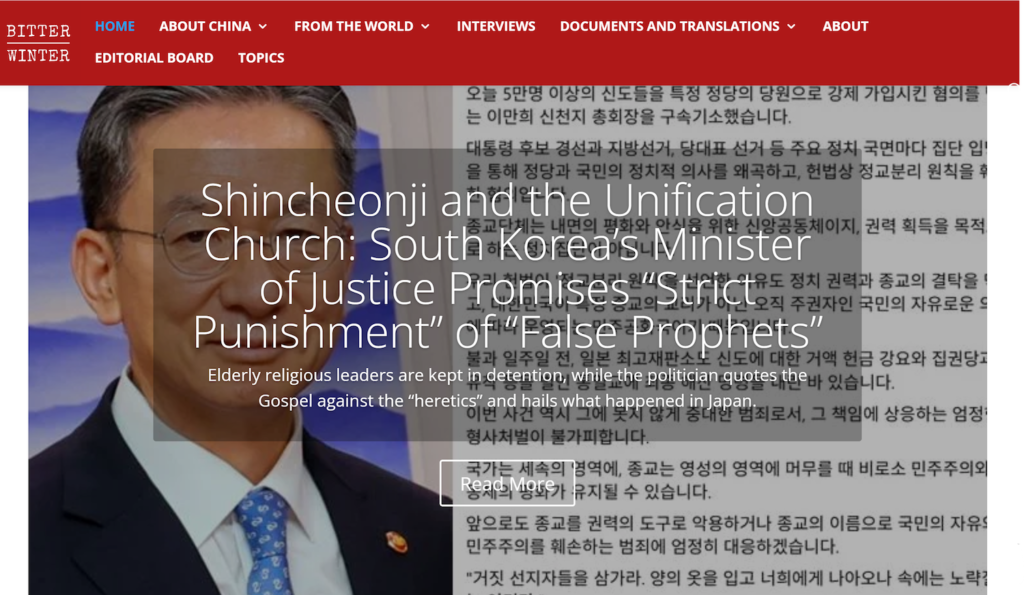
Justice Minister publicly states that “strict criminal punishment is inevitable” while case is pending
Scholar raises concerns about judicial impartiality, religious neutrality, and international human rights standards
SEOUL, South Korea — July 6, 2026 — International attention is growing over the detention and prosecution of Chairman Lee Man-hee, the 95-year-old leader of Shincheonji Church of Jesus, and over recent public remarks made by South Korea’s Minister of Justice, Jeong Seong-ho.
Chairman Lee was taken into custody on June 24 on charges including alleged violations of the Political Parties Act. The charges do not involve allegations of violence. On June 30, prosecutors formally indicted him while he remained in detention.
The same day, Justice Minister Jeong Seong-ho announced the indictment on his social media account, writing that “strict criminal punishment corresponding to its responsibility is inevitable.” He concluded the post by quoting Matthew 7:15: “Beware of false prophets.”
The minister’s comments have drawn criticism from Dr. Massimo Introvigne, an Italian sociologist of religion, who argues that the remarks risk creating the appearance of prejudging an ongoing criminal case.
Dr. Introvigne discussed the case in two articles published by Bitter Winter, a publication covering religious freedom and human rights. His first article, published on June 24 following Chairman Lee’s arrest, questioned the necessity of detaining a 95-year-old religious leader. His second article, published on July 2, focused on the Justice Minister’s public comments and their implications for judicial impartiality.
Sociologist Dr. Massimo Introvigne, writing in Bitter Winter, described the situation as “a stain on South Korea’s democratic credentials.”
Questions Raised Over Detaining a 95-Year-Old Religious Leader
According to prosecutors, Chairman Lee organized the enrollment of approximately 50,000 Shincheonji members into the People Power Party (PPP) between July 2021 and January 2024 in an effort to influence the party’s presidential and parliamentary primary elections.
Dr. Introvigne argues that placing a 95-year-old religious leader in pretrial detention in a case that does not involve allegations of violence raises concerns about proportionality under international human rights principles, including the UN Standard Minimum Rules for the Treatment of Prisoners (the Mandela Rules) and principles discussed by the UN Working Group on Arbitrary Detention.
He also compared the case to the separate detention of Han Hak-ja, the 83-year-old leader of the Family Federation for World Peace and Unification (formerly the Unification Church), arguing that the cases suggest an emerging pattern in which elderly leaders of controversial religious movements are being placed in detention.
Following Chairman Lee’s arrest, Shincheonji Church of Jesus stated that both Chairman Lee and the church had fully cooperated throughout the investigation, including search and seizure procedures. The church described the detention as “in effect a physical punishment imposed on a 95-year-old suspect.”
Criticism of the Justice Minister’s Public Remarks
Dr. Introvigne expressed particular concern over the timing of Minister Jeong’s statement, noting that it was issued on the very day Chairman Lee was formally indicted.
He argues that when the government official responsible for overseeing the justice and prosecution system publicly declares that severe punishment is “inevitable” before a trial has begun, it may create the appearance of prejudging the case.
Dr. Introvigne also questioned the minister’s decision to conclude the statement with the biblical warning, “Beware of false prophets.” He argues that when such language is used by a sitting Justice Minister in connection with an ongoing prosecution involving the leader of a religious movement, it may raise concerns regarding the state’s obligation to maintain religious neutrality.
The Central Legal Question: Was There Coercion?
At the heart of the case is not whether Shincheonji members joined a political party, but whether they were coerced into doing so.
Prosecutors allege that the evidence demonstrates an organized campaign of forced enrollment. Shincheonji Church of Jesus disputes that allegation, maintaining that members joined voluntarily and were not compelled by force or organizational directive.
According to Dr. Introvigne, the trial is likely to depend on whether prosecutors can establish coercion through sufficient evidence and legal reasoning. He argues that criminal liability should not arise solely because individuals belong to a religious minority and participate in political activities that are otherwise lawful.
A Test of Democratic Principles
Dr. Introvigne argues that the case is being closely followed by observers concerned with religious freedom because it raises broader questions about how democratic societies treat minority religious communities.
He contends that if statements by senior government officials appear to influence judicial independence or undermine a defendant’s right to a fair trial, the consequences extend beyond a single prosecution and may affect public confidence in the rule of law.
“A genuine democracy,” he argues, “must apply the same legal protections and procedural safeguards to minority religious groups as it does to every other citizen.”
Describing the case as “a stain on South Korea’s democratic credentials,” Dr. Introvigne said it is “a matter the world should pay attention to.”